What Is White Rose Maths?
White Rose Maths is a mastery-based maths curriculum used by approximately 80% of UK primary schools. It was developed by teachers for teachers, with the goal of helping every child succeed at maths through small, connected steps.
The approach breaks down maths concepts into manageable chunks, ensuring children truly understand each building block before moving forward. This contrasts with traditional curricula that might rush through topics without checking for deep comprehension.
White Rose Maths aligns perfectly with the UK National Curriculum, but it provides more detailed lesson sequences and clearer progression steps. Teachers love it because it reduces planning time whilst maintaining high standards.
Why White Rose Maths at Home Matters
Even though your child's school teaches White Rose Maths during the day, regular practice at home reinforces what they've learned and prevents gaps from forming. Research shows that consistent, short practice sessions are far more effective than occasional long ones.
The challenge is knowing what to practise. Schools move through topics quickly, and what your child learned last week might be completely different from this week's focus.
That's where understanding the White Rose Maths structure becomes invaluable. When you know where your child is in the curriculum, you can provide targeted support rather than random worksheets.
How to Access Free White Rose Maths Resources
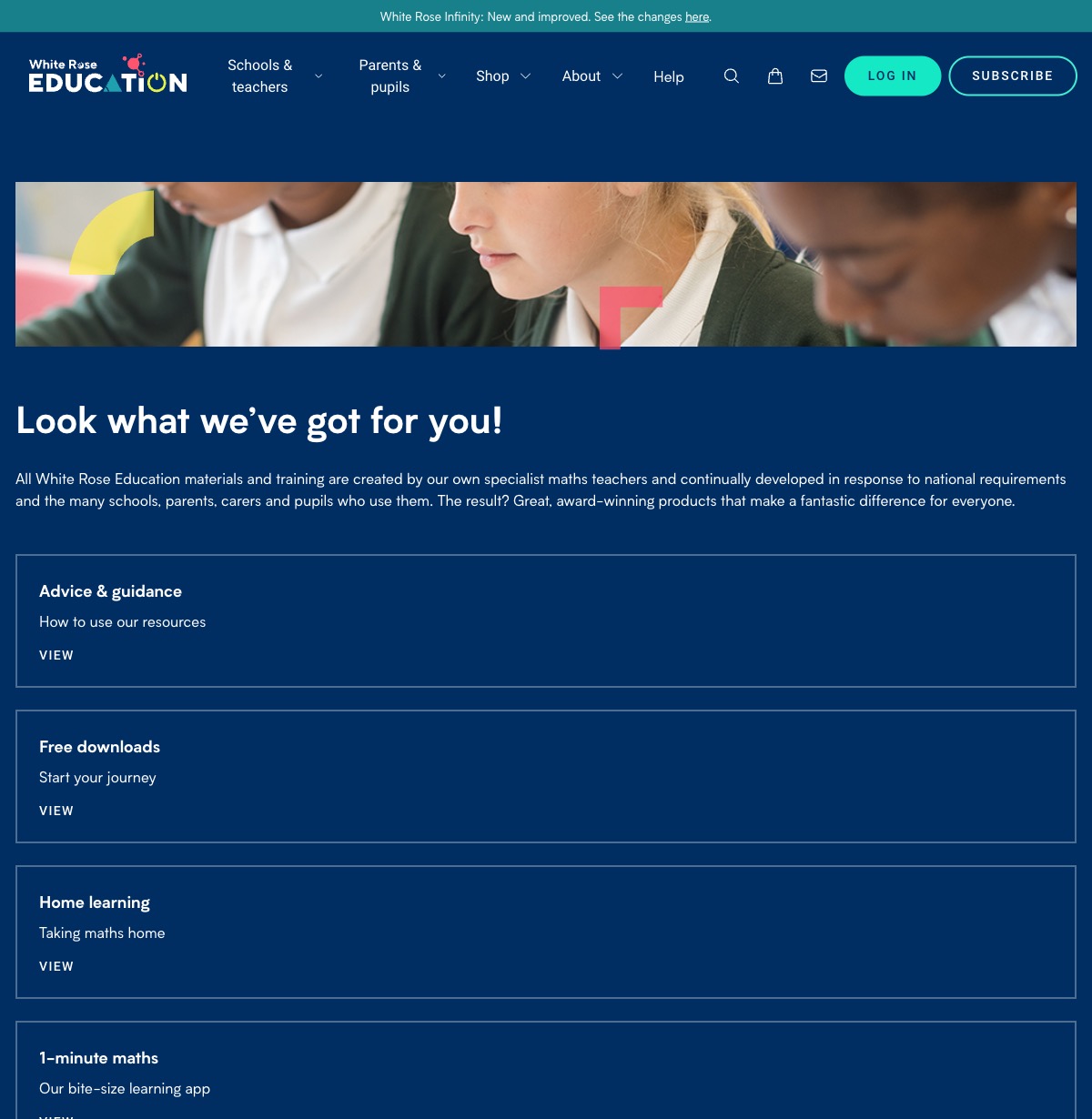
White Rose Education offers a substantial collection of free resources for parents. Here's what you'll find:
Schemes of Learning
These are the detailed maps showing what children learn in each year group, broken down by term. Download the scheme for your child's year, and you'll see every topic they'll cover throughout the year.
Each topic includes learning objectives, suggested resources, and links to related concepts. It's the same document teachers use for planning.
Parent Resources
The White Rose parent hub includes video tutorials, topic overviews, and activity suggestions. These are written in plain English without educational jargon.
Videos typically run 5-10 minutes and explain not just what children are learning, but why it's taught that way. Understanding the reasoning helps you support more effectively.
Home Learning Packs
During term breaks, White Rose releases home learning packs—workbooks with a week's worth of activities. These are completely free to download and print.
Each pack includes answer sheets, so you don't need to work out the answers yourself. The activities are structured to maintain skills during holidays without overwhelming children.
Matching Games and Apps to White Rose Topics
Worksheets aren't the only way to practise White Rose Maths at home. In fact, age-appropriate maths games often work better because they maintain engagement without triggering homework resistance.
The trick is matching activities to your child's current White Rose topic. Here's how:
Step 1: Identify the Current Topic
Ask your child's teacher which White Rose unit they're currently studying. Most teachers are happy to share this information. Alternatively, check the school's curriculum overview—many publish termly plans online.
Common Year 4 autumn topics include place value (4-digit numbers), addition and subtraction, and multiplication tables. Year 5 students might be working on fractions, decimals, or negative numbers.
Step 2: Find Aligned Activities
Once you know the topic, look for games or apps that specifically practise those skills. For example:
- Place Value: Number line games, digit card challenges, or apps where children build numbers from parts
- Fractions: Pizza or chocolate bar division games, fraction wall activities, or comparison challenges
- Times Tables: Speed challenges, pattern spotting, or multiplication-based adventure games
- Measurement: Real-life projects (cooking, building), estimation games, or unit conversion puzzles
The key is variety within the topic. White Rose Maths emphasises variation—practising the same concept in different contexts builds deeper understanding.
Step 3: Schedule Little and Often
Rather than hour-long weekend sessions, aim for 10-15 minutes daily. This matches how White Rose Maths lessons are structured: short, focused bursts that allow concepts to sink in.
Try attaching practice to an existing routine. After breakfast, before screen time, or during the car journey to activities—wherever it naturally fits.
Weekly Practice Schedules by Year Group
Here are realistic practice schedules that align with White Rose Maths pacing. Adapt these based on your child's needs and your family's schedule.
Year 3 (Ages 7-8)
Monday-Friday: 10 minutes daily
Focus: Times tables (2, 3, 4, 5, 8, 10), place value to 1,000, addition/subtraction to 100
Activities: Quick-fire times tables (5 mins), one word problem or game (5 mins)
Year 4 (Ages 8-9)
Monday-Friday: 15 minutes daily
Focus: All times tables to 12×12, place value to 10,000, written calculation methods
Activities: Times tables practice (5 mins), current White Rose topic game or activity (10 mins)
Year 5 (Ages 9-10)
Monday-Friday: 15-20 minutes daily
Focus: Fractions, decimals, percentages, multi-step problems
Activities: Mental maths warm-up (5 mins), targeted practice on current topic (10-15 mins)
Year 6 (Ages 10-11)
Monday-Friday: 20 minutes daily
Focus: Algebra basics, ratio, advanced fractions/decimals, SATs preparation
Activities: Mixed mental maths (5 mins), reasoning problems or current topic work (15 mins)
How to Know If Your Child Is On Track
White Rose Maths expects children to master certain concepts by the end of each year. Here's a quick milestone checklist:
End of Year 3
- Know times tables for 2, 3, 4, 5, 8, 10 (working towards others)
- Add and subtract numbers up to 3 digits using column method
- Recognise and work with simple fractions (halves, quarters, thirds)
- Measure lengths, masses, and volumes using standard units
End of Year 4
- Instant recall of all times tables up to 12×12
- Use formal written methods for addition, subtraction, and multiplication
- Convert between different units of measure
- Understand decimal notation in context of money and measurement
End of Year 5
- Multiply and divide by 10, 100, 1000
- Add and subtract fractions with different denominators
- Solve multi-step word problems
- Calculate percentages of amounts
End of Year 6
- Use long multiplication and division
- Work confidently with fractions, decimals, and percentages
- Solve problems involving ratio and proportion
- Apply maths to real-world contexts independently
If your child is struggling with several items on their year group's list, it's worth speaking to their teacher about extra support. Early intervention prevents small gaps from becoming large obstacles.
Common Mistakes Parents Make (And How to Avoid Them)
Even with the best intentions, parents sometimes undermine White Rose Maths without realising it. Here are the most common missteps:
Mistake 1: Teaching Methods You Learned
The maths you learned at school probably looked different. White Rose Maths uses bar models, part-whole diagrams, and number lines—tools that might seem unfamiliar.
Resist the urge to say "just do it this way" and show your old method. Your child's teacher is building conceptual understanding through specific representations. Introducing different methods too early causes confusion.
Instead, watch the White Rose parent videos to understand why concepts are taught the way they are. Once you grasp the reasoning, you can support rather than contradict.
Mistake 2: Moving Too Fast
White Rose Maths is deliberately paced to ensure mastery. If your child has grasped a concept quickly, the temptation is to race ahead to harder content.
But mastery isn't just getting answers right—it's understanding why, explaining your thinking, and applying concepts in varied contexts. Instead of moving forward, go deeper with the current topic.
Mistake 3: Random Worksheets
Grabbing any Year 4 maths worksheet from the internet might not align with what your child is currently learning. Out-of-sequence practice can be demotivating and unhelpful.
Always check that activities match your child's current White Rose unit. Focused, relevant practice beats random drilling every time.
Mistake 4: Overloading Homework Time
If your child already receives maths homework from school, adding extensive extra practice can backfire. Children need downtime, and overwork breeds resentment.
Keep home practice short and playful. If resistance appears, it's a sign to pull back, not push harder.

Integrating Apps and Games with White Rose Maths
One of the questions parents ask most frequently is whether educational games and apps can replace traditional practice. The answer is yes—if they're properly aligned.
Recent research on gamification in maths learning shows that well-designed educational games produce learning outcomes equal to or better than worksheets, whilst maintaining higher engagement.
Apps like MathCraft are explicitly built around White Rose Maths progression, meaning each quest or challenge aligns with specific curriculum topics. When your Year 4 child plays a quest about multiplication, it's practising the exact skills they're learning in school—just disguised as an adventure.
The benefit is consistency without coercion. Children voluntarily engage because it feels like play, but they're consolidating White Rose concepts through spaced repetition and adaptive challenges.
When to Ask for School Support
White Rose Maths at home works brilliantly for most children, but some need additional school-based intervention. Warning signs include:
- Consistent difficulty with age-appropriate content despite regular practice
- Anxiety or tears during maths activities
- Falling behind on multiple topics simultaneously
- Teacher expressing concerns about progress
Don't wait for end-of-year results. Speak to your child's teacher as soon as concerns arise. Schools often provide small-group interventions or one-to-one support that can close gaps quickly.
White Rose Maths itself is designed to support all learners, but some children need more time, different explanations, or targeted help with specific areas. That's completely normal and nothing to worry about—early action is what matters.
Resources for Different Learning Styles
White Rose Maths accommodates various learning preferences, and your home practice can too:
Visual Learners
Use manipulatives (blocks, counters, fraction walls), bar models, and diagrams. White Rose lessons are built on visual representations, so this aligns perfectly.
Kinaesthetic Learners
Incorporate movement and real objects. Baking for fractions, building for measurement, outdoor number hunts—anything that gets them moving whilst practising maths.
Auditory Learners
Talk through problems together, use songs for times tables, or listen to maths story podcasts. Explaining their thinking out loud reinforces learning.
Digital Learners
Interactive apps, online games, and video tutorials work well. Just ensure they align with White Rose topics rather than presenting random maths.
Most children benefit from a mix. Variety keeps practice engaging and builds understanding through multiple pathways.
Creating a White Rose Maths-Friendly Home Environment
Supporting White Rose Maths at home isn't just about formal practice—it's about making maths visible in daily life.
Keep a "maths corner" with basic manipulatives: counters, a ruler, a number line, fraction circles. When questions arise, children can grab tools to work things out.
Talk about maths casually. "We need 600g of flour—how many 200g cups is that?" or "The recipe serves 4, but we're 6 people. How do we adjust?" These natural problems apply White Rose concepts in real contexts.
Display times tables charts, number bonds, or the White Rose calculation flowcharts. Seeing information regularly aids memorisation without explicit drilling.
Looking Ahead: Progression Through the Years
One of White Rose Maths' greatest strengths is its coherent progression. Topics aren't taught in isolation—they build systematically year after year.
Understanding how concepts develop helps you support long-term learning. For example:
- Year 1-2: Foundation number sense, counting, simple addition/subtraction
- Year 3-4: Consolidation of basics, introduction to formal methods, times tables mastery
- Year 5-6: Complex fractions/decimals, multi-step reasoning, preparation for secondary maths
Each stage prepares children for the next. If earlier concepts are shaky, later learning becomes difficult. That's why consistent, aligned practice matters—you're not just helping with this year's work, you're building foundations for years ahead.
Frequently Asked Questions
What is White Rose Maths?
White Rose Maths is a mastery-based curriculum used by approximately 80% of UK primary schools. It breaks down maths concepts into small, connected steps and ensures children fully understand each building block before moving forward. The approach aligns with the National Curriculum but provides more detailed lesson sequences and progression maps.
Is White Rose Maths free for parents?
Yes, White Rose Education provides extensive free resources for parents including schemes of learning, topic overviews, video tutorials, and home learning packs. These are available on their website and designed to help parents support their child's learning at home without requiring any maths teaching expertise.
How do I use White Rose Maths at home?
Start by identifying which White Rose topic your child is currently studying at school. Download the relevant scheme of learning and parent resources from the White Rose website. Then provide 10-20 minutes of daily practice using activities, games, or worksheets that align with that specific topic. Focus on short, regular sessions rather than occasional long ones.
Do all schools use White Rose Maths?
No, not all schools use White Rose Maths, though approximately 80% of UK primary schools have adopted it. Some schools use alternative mastery schemes or their own curriculum plans. Check with your child's school to confirm whether they follow White Rose Maths—this information is usually available on the school website or by asking the teacher directly.
What if my child is struggling with White Rose Maths?
If your child consistently struggles despite regular practice, speak to their teacher about additional support. Schools often provide small-group interventions or one-to-one help. At home, go back to earlier White Rose units to ensure foundational concepts are solid—gaps in understanding compound over time, so addressing them early prevents larger problems later.
Want to Try a Game That Aligns with White Rose Maths?
MathCraft turns White Rose topics into adventures—your child practises the exact curriculum they're learning at school, but disguised as quests with pets and island-building. No worksheets, no resistance, just maths mastery through play.
Try MathCraft Free No card required. Completely free.